
Why Hand-Painted Bedding Feels Different
Every original painting begins with a moment of uncertainty.
A blank canvas.
A loaded brush.
And a decision about where the first mark should fall.
Nothing has been repeated yet. Nothing copied. Nothing perfected. Only observed.
Long before a Luxotic design becomes bedding, it begins in exactly this place: an artist standing in front of a blank canvas, working from instinct rather than instruction.
That beginning shapes everything that follows. It's why hand-painted textiles carry a kind of depth that's hard to name but easy to recognise. They hold something beyond colour and pattern. They hold the decisions of the person who made them.

A brushstroke is never just a brushstroke
Ask two artists to paint the same lotus flower.
Neither painting will look alike.
One brush lingers. Another lifts away almost immediately.
One allows colour to pool. Another lets it disappear.
Neither decision is planned. Both are instinct.
Multiply that instinct across hundreds of brushstrokes and something happens that no software can genuinely reproduce. A machine can repeat a shape with total precision. An artist, working by hand, rarely wants to. Perfect repetition is the one thing a hand-painted piece is not trying to achieve.
That subtle unevenness is what gives the artwork its presence. Every stroke carries not just colour, but judgement, restraint and feeling, laid down in a fraction of a second and never quite repeatable again.
Nature rewards observation
Symmetry, it turns out, is rare in nature. Leaves twist toward whatever light happens to reach them. Petals fade unevenly, some browning at the tip while the base still holds colour. No two flowers on the same stem open in quite the same way.
The finest botanical paintings don't correct any of this. They honour it. The artist isn't trying to improve on the flower in front of them. They're paying attention to it, closely enough to notice what a passing glance would miss.
That attention becomes part of the finished work. It's quietly there in the brushwork, waiting for someone else to slow down long enough to notice it too.
Jungle Lotus: a landscape, not a print
This is where Jungle Lotus begins.
The design draws on a real place, or rather, several: tropical north Australia, a family home in the Pacific, and travels through Southeast Asia. Rather than painting from a single photograph, the artist worked the way memory itself works, blending watercolour with digital layering to build something closer to a recollection than a photograph. Mist softens the background. Colour intensifies where the eye is meant to land. It reads less like a botanical illustration and more like the feeling of walking into a warm, humid garden after rain.
That's also why Jungle Lotus was never conceived as a repeating pattern. It's a landscape, layered with foliage and lotus flowers caught at different stages of life.
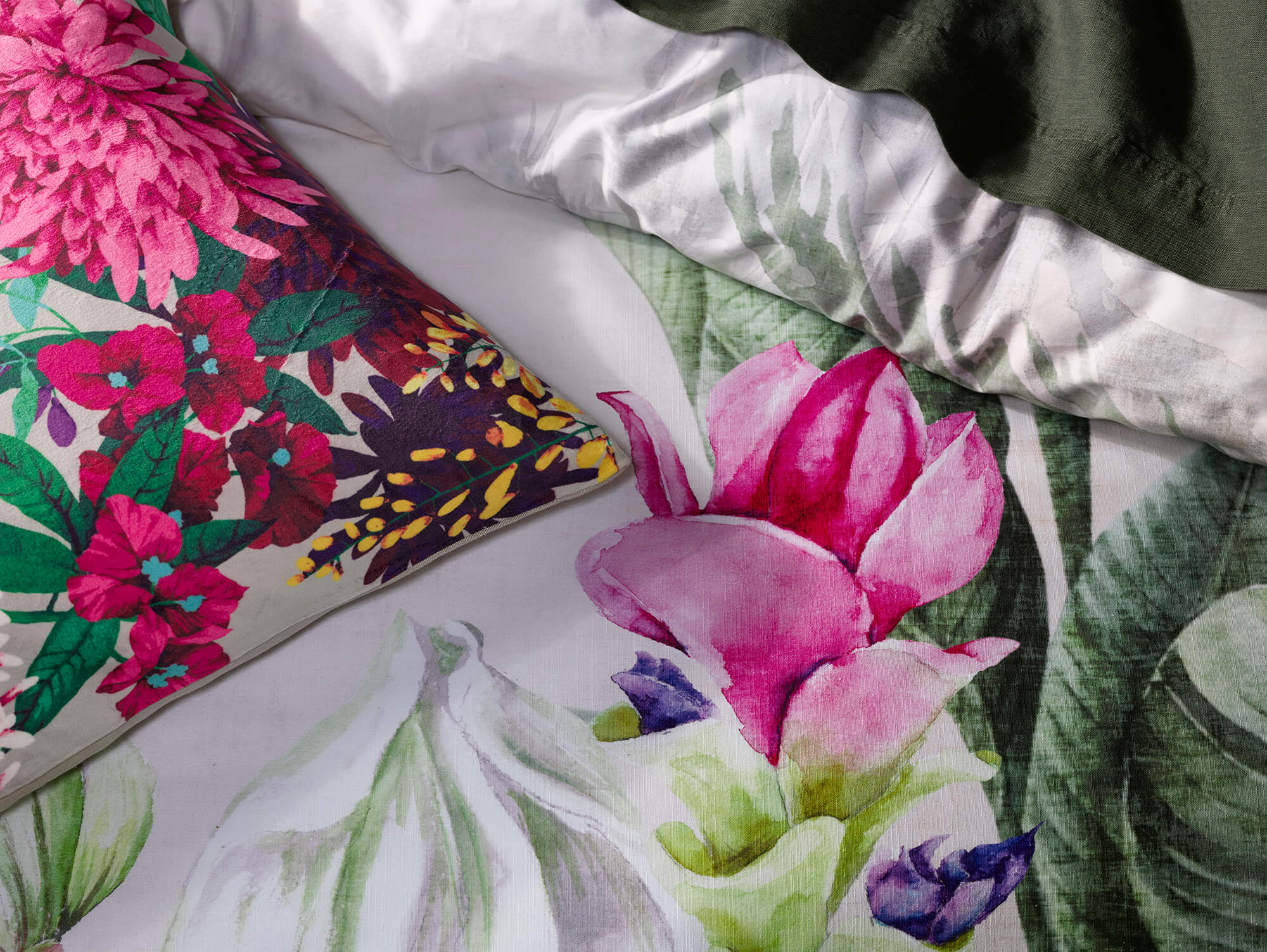
Look closely and the flowers are never quite the same twice. A tight green bud sits low in one corner. Nearby, a bloom has only just started to part. Elsewhere, a lotus has opened fully, its petals catching the light differently to the one beside it. None of it announces itself as a sequence. Some people notice the progression on the first morning. Others live with it for weeks before they see it. Both experiences feel right, because that's how a real garden works too: not all at once, but gradually, on its own time.

Close-up detail: lotus buds and blooms at different stages within Jungle Lotus.
From canvas to cloth
Finishing the painting is only the first half of the work. Carrying it onto fabric without losing what made it worth painting in the first place is its own craft.
The soft edge where one colour fades into the next has to survive the printing process. The texture of a brushstroke, the place where pigment pooled slightly before drying, has to remain visible instead of flattening into a clean digital line. Fine detail has to hold its clarity stretched across an entire quilt cover, not just in the small swatch it started as.
The goal was never to reproduce the painting. It was to preserve what it felt like to stand in front of it.
Great design reveals itself slowly
Some objects make their case immediately. Others take longer, and end up mattering more because of it.
A favourite painting looks different depending on what time the light hits it. A well-used ceramic bowl becomes the one you reach for without thinking, not because it's the nicest one, but because it's the most familiar. The most enduring things are rarely the loudest. They ask for a little patience, and pay it back with interest.
Hand-painted textiles belong to that category. They aren't built to give everything away in the first ten seconds. They're built to be lived with.
Living with art
There is a difference between owning artwork and living with it.
A painting on a gallery wall asks for your attention.
Artwork inside a home earns it gradually. Morning after morning. Season after season.
The bedroom is one of the few rooms in a home we return to every single day. Once artwork moves off a gallery wall and onto a bed slept in that often, something in it changes. It stops being something looked at occasionally and becomes part of how the room actually feels: morning light through curtains hitting the same lotus bloom differently every day of the week.

Living with art, morning after morning.
Perhaps that is why a bedroom deserves objects that keep revealing themselves. Not through novelty. Through familiarity.
The room becomes more than somewhere to sleep. It becomes a space shaped by colour, texture and someone else's careful attention, where familiarity deepens the piece rather than wearing it out.
The enduring appeal of the handmade
In a world where almost anything can be generated, copied and reproduced in seconds, handmade objects are a reminder that creativity still starts with a person's judgement, and a person's hand.
Perhaps this is why handmade objects age so well. They were never trying to impress us all at once.
Original artwork was never really about perfection. It was about noticing something worth painting, slowing down long enough to do it properly, and trusting that someone else will eventually slow down too.
That's likely the real reason handmade pieces feel different. Not because they demand attention. Because they reward it, for as long as you keep paying it.
Long after the trends around it have changed, the brushstrokes stay exactly where the artist left them. The colours keep catching the light differently depending on the hour. The artwork keeps offering something new, quietly, on its own schedule.
Featured: Jungle Lotus Quilt Cover Set
