
Why Beautiful Rooms Don't Happen All at Once
The rooms we love most are collected over time.
A room can be furnished in a weekend. It takes much longer to make it yours.
You can choose the bed, find the lamps, hang the artwork and arrange everything exactly as planned. By the end of it, the room may look complete.
But complete and personal are not always the same thing.
Think about the rooms you have loved living in. Chances are, not everything arrived at once.
There might be a chair that has followed you from another home. Books accumulated without any thought for how their spines would look together. A bowl bought on holiday. A lamp chosen years after the table beneath it. Something inherited that you would never have selected for yourself, but couldn't imagine getting rid of.
None of these decisions were part of a single decorating plan.
Perhaps that is precisely the point.
The rooms that feel most personal are often shaped gradually, as life gives us reasons to add, remove, move and reconsider things.
They aren't finished in one moment.
They become.
The temptation to finish
An empty room presents us with a series of questions.
What goes on that wall?
What belongs beside the bed?
Does that corner need a chair?
Would another cushion make everything feel more complete?
It is tempting to answer every question immediately.
There is satisfaction in seeing a room come together, particularly when interiors are so often presented to us in their finished state. We see the photograph after the artwork has been hung, the books arranged and the last object placed on the table.
We rarely see the years before it.
Yet some of the things that eventually make a room interesting couldn't have been chosen at the beginning, because they hadn't entered our lives yet.
That is the limitation of trying to finish a room too quickly.
We leave no space for what we haven't found.

Taste doesn't stand still
The other reason rooms benefit from time is that we change.
Something we were certain about five years ago may no longer interest us. A colour we once avoided can suddenly feel right. An object we bought almost casually can become the thing we would save first.
Living with a room teaches us things that planning it cannot.
We discover where the morning light falls.
Which chair everyone actually chooses.
Which surfaces inevitably collect books.
Which colours become richer in the afternoon.
Which things we stop seeing altogether.
Gradually, the room begins responding less to an original plan and more to the life taking place inside it.
Perhaps that is when decorating becomes something more interesting than decoration.
Matching is not the same as belonging
There is comfort in coordination.
Matching bedside tables. Repeated finishes. A controlled palette. Objects chosen because they share the same visual language.
It can make a room feel resolved.
But belonging is something different.
An old timber piece can sit beside a contemporary lamp. A quiet wall can hold exuberant artwork. Something polished can become more interesting beside something weathered.
They may have different origins, ages and intentions.
Still, somehow, they work.
Often the connection is subtle. A proportion repeated elsewhere. A colour that appears only twice. Similar shapes expressed through completely different materials.
And sometimes there is no obvious connection at all.
We simply like both things enough to give them a place.
A room doesn't always need a better reason than that.
The unexpected piece
In fact, the object that seems slightly outside the plan can sometimes be the one that changes everything.
A patterned textile in an otherwise restrained bedroom.
An antique piece among contemporary furniture.
A colour that appears nowhere else.
Something unusually large, small, ornate or playful.
Perfect coordination can make a room easy to understand. The unexpected makes us look again.
This is where expressive design can have particular power.
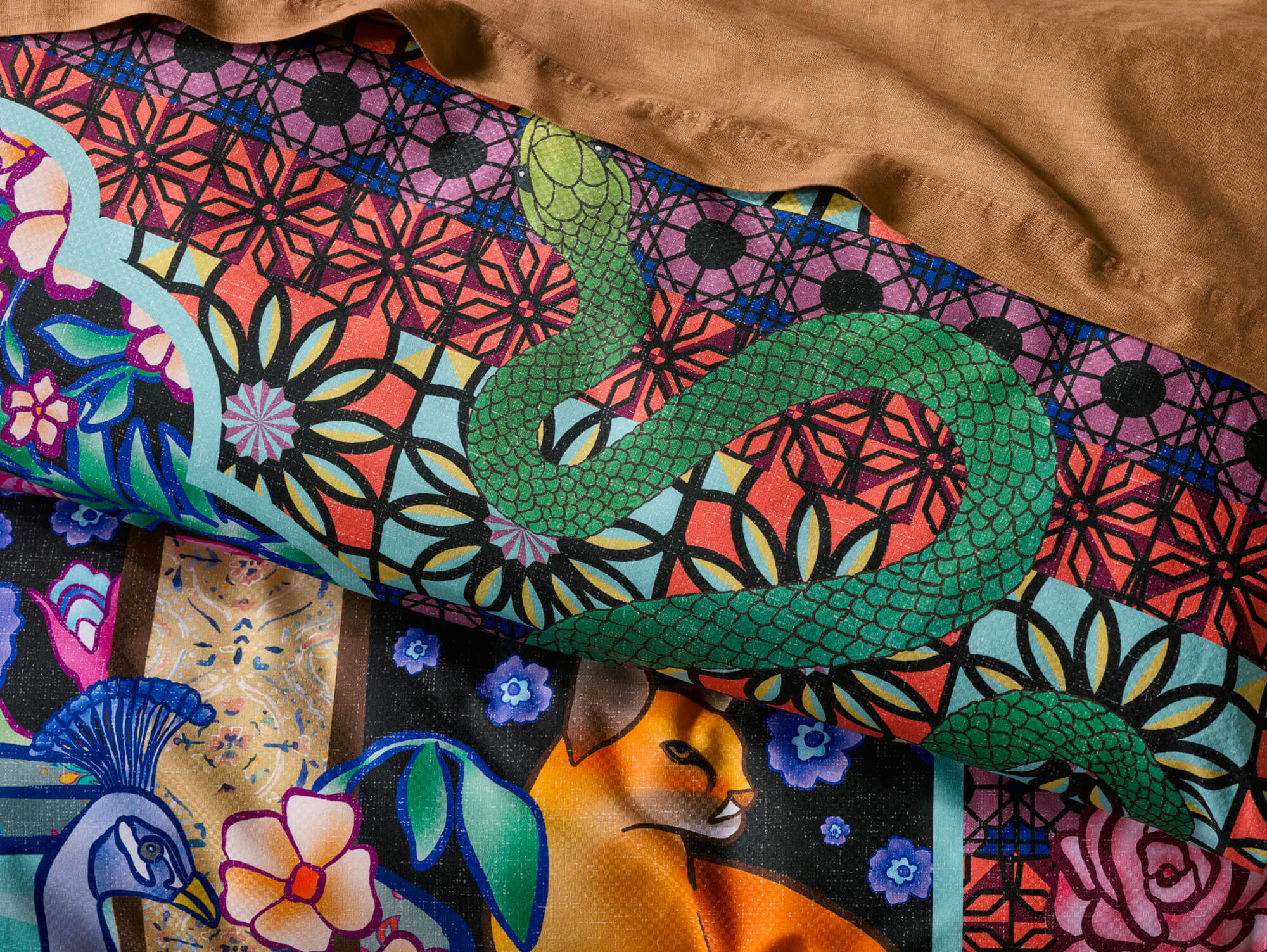
A collection such as Aria Black doesn't need every element around it to repeat its pattern or colours. Against timber, books, familiar furniture and quieter surfaces, its painted forms can exist as their own presence.
It isn't there to make everything match.
It brings another voice into the room.

Aria Black, styled against a calm, neutral room.
The value of waiting
There is another possibility we don't always allow ourselves when decorating.
Leaving something empty.
A bare wall doesn't necessarily need artwork this weekend.
An unused corner isn't automatically asking for furniture.
A bedside table doesn't need to be filled simply because there is space on it.
Sometimes the right decision is not knowing yet.
Waiting allows a room to develop in ways we couldn't have planned.
Perhaps you find the painting a year later. Perhaps a piece from another part of the house eventually belongs there. Perhaps the empty space turns out to be exactly what the room needed.
This isn't an argument for unfinished rooms.
It is an argument for allowing them to remain open.
New things can belong too
A collected interior doesn't mean everything needs history.
New things matter.
They become part of a room in exactly the same way older pieces once did: by being chosen, used and lived with.
What matters is less about age than intention.
Choosing something because you genuinely respond to it creates a different relationship from choosing it simply because there is an empty space to fill.
This is particularly true of expressive pieces.
You may not know exactly how they will relate to everything you own. They may introduce a colour you haven't used before or a pattern that changes the mood of the room.
That slight uncertainty can be valuable.
A room should still have somewhere to go.
Eventually, you stop decorating
There comes a point when the individual decisions become harder to see.
The lamp you deliberated over is simply the lamp beside the bed.
The artwork you once worried was too large looks as though the wall was always waiting for it.
The bedding is washed, remade and lived in until it becomes part of the familiar appearance of the room.
Things move.
New things arrive.
Others quietly disappear.
And somewhere along the way, the room stops looking like a collection of decorating decisions.
It simply looks like yours.
Perhaps that is why the most memorable interiors are difficult to reproduce.
Their character isn't contained in one particular chair, colour, artwork or textile. It comes from the relationship between things chosen at different moments for different reasons.
You can borrow the palette.
You can find similar furniture.
You can even recreate the arrangement.
But you cannot recreate the time that brought everything together.

Give the room time
There is nothing wrong with wanting a beautiful room now.
Choose the things you love. Paint the walls. Make the bed beautifully. Bring home the piece you can't stop thinking about.
But leave something for later.
Leave room for your taste to change.
Leave room for something unexpected.
Leave room for the object you haven't found yet.
A beautiful room doesn't need to arrive fully formed.
Sometimes it becomes more interesting precisely because it didn't.
Featured: Aria Black Quilt Cover Set
